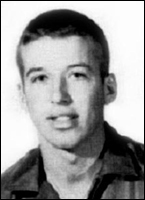

John Calvin Clark II was a Captain in the United States Air Force when he went Missing in Action in Laos on 05 February 1969. Clark was born on 30 January 1943, and his home city of record is Brownfield, Texas. Clark's remains were returned in 1995 and identified in 1997.
Leading up to the Incident
In violation of the neutrality of Laos accorded at Geneva in a 14-nation protocol conference July 23, 1962, the North Vietnamese and supporting communist insurgent group, the Pathet Lao, lost no time in building strategic strongholds of defense in Northern Laos and establishing a steady flow of manpower and material to their revolutionary forces in South Vietnam via the Ho Chi Minh Trail on the eastern border of the Laotian panhandle.
As a result, the Royal Lao sought help from the U.S. In turn, U.S. involvement in Laos was justified by an expected quick victory in Vietnam. Every initiative had to be cleared through the U.S. Ambassador at Vientiane, so that the delicate balance of "look-the-other-way-neutrality" engaged in by the nations involved (including China) could be preserved. Before many years passed, however, it became clear that the U.S. would have no "quick victory" in Vietnam, and the secret war in Laos grew more difficult to contain.
Defense of non-communist activity in Laos generally fell into three categories: 1) U.S. Army and CIA's bolstering of the Meo (Hmong) army led by General Vang Pao; 2) Strategic U.S. Air Force bombing initiatives on the Ho Chi Minh Trail (Operations Commando Hunt, Steel Tiger, etc.); 3) U.S. Air Force bombing initiatives in northern Laos (Operation Barrell Roll, etc.) both against communist strongholds there, and in support of the Royal Lao and Gen. Vang Pao's army.
The Incident
1Lt. Patrick K. Harrold and Capt. John C. Clark II were pilots assigned to an F4E Phantom fighter jet dispatched on an operational mission over Laos on February 5, 1969. Their mission would take them to the northeast edge of the Plain of Jars in Xiangkhoang Province in Military Region II.
At a point about 10 miles northwest of the city of Nong Het, the Phantom was shot down and both crew members declared Missing in Action. The Air Force told the Harrold and Clark families that there was every reason to believe the enemy knew the fate of both men; that perhaps they had been captured. It was too soon to tell.
When the war finally ended for the U.S. in Southeast Asia, families of the nearly 600 men lost in Laos were horrified to learn that no negotiations had been struck that would free Americans held in Laos. The Pathet Lao had stated publicly that they held "tens of tens" of American prisoners, but they wished to be negotiated with. The U.S. was not willing to negotiate with the communist faction, even at the cost of abandoning some of their best men.
Sources
Biographical and incident of loss information was obtained from either POW/NET and/or Task Force Omega, Inc (unless otherwise noted). Additional information may be found via remembrances at The Vietnam Veterans Memorial Fund or The Virtual Wall Vietnam Veterans Memorial.