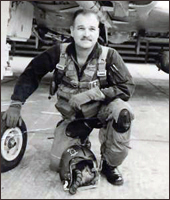

William Edward Campbell was a Major in the United States Air Force when he went Missing in Action in Laos on 29 January 1969. Campbell was born on 10 May 1931, and his home city of record is McAllen, Texas. Campbell's remains were recovered in 2014, identified in 2016, and buried in 2017.
The F4 Phantom
The F4 Phantom, used by Air Force, Marine and Navy air wings, served a multitude of functions including fighter-bomber and interceptor, photo and electronic surveillance. The two man aircraft was extremely fast (Mach 2), and had a long range (900 - 2300 miles, depending on stores and mission type). The F4 was also extremely maneuverable and handled well at low and high altitudes. The F4 was selected for a number of state-of-the-art electronics conversions, which improved radar intercept and computer bombing capabilities enormously. Most pilots considered it one of the "hottest" planes around.
The Incident
Major William E. Campbell was a Phantom pilot assigned a combat mission over Laos on 29 January 1969. His bombardier/navigator on the mission was Capt. Robert E. Holton. Their mission would take them to the Mu Gia Pass area of Laos.
The Mu Gia Pass was one of several passageways through the mountainous border of Vietnam and Laos. American aircraft flying from Thailand to missions over North Vietnam flew through them regularly, and many aircraft were lost. On the Laos side of the border coursed the "Ho Chi Minh Trail," a road system heavily traveled by North Vietnamese troops moving materiel and personnel to their destinations through the relative safety of neutral Laos, coursing into Laos through the Mu Gia Pass and traveling south. The return ratio of men lost in and around the passes is far lower than that of those men lost in more populous areas, even though both were shot down by the same enemy and the same weapons. This is partly due to the extremely rugged terrain and resulting difficulty in recovery.
During the mission, Campbell's aircraft was hit by enemy fire and crashed. Both Campbell and Holton were listed Missing in Action since the distinct possibility existed that they both survived to be captured.
Personal Information
William E. Campbell, who graduated from Texas A & M in 1952, was promoted to the rank of Colonel during the period he was maintained missing. In 2017, Campbell was buried with honors at Arlington National Cemetery; read this article for more information.
From Cathy Campbell (to the POW Network)
I am the oldest of four children in an Air Force family. I was born in 1951 the year before my Dad graduated from Texas A & M. He went directly into the military choosing the Air Force as his career. My Dad had just graduated from the Air Force Institute with a Master's degree in Logistics, and we were on our way to Tucson, Arizona, where he would receive his F-4 fighter pilot training. He had volunteered for a tour of duty in Vietnam, and on Memorial weekend of 1968, he left for Ubon, Thailand. He was 38 years old. Mom and we children moved to Independence, Kansas, to be closer to her parents.
Dad's squadron was called the "Nite Owls" because they flew their missions at night. Flying over Laos they bombed in North Vietnam. His tour was to be at least 6 months long during which he had to accomplish 100 missions. In order for a mission to be a "counter", their ordinance (weapons) had to destroy a military target in enemy territory; otherwise, the mission was considered a "freebie." Daddy's plan was to finish his tour by Christmas, and then our next assignment was a Logistics position for him in Hawaii.
President Johnson called a bombing halt in October 1968, and this put a serious delay in my Dad's plan to get his 100 missions completed by Christmas. He did, however, travel to Kansas on leave to spend Christmas with us. I remember sitting in church for a midnight Christmas Eve service studying my Dad's eyes. I wondered what was really going on over there. He said one thing, but I felt his eyes had something else to say.
He returned to Thailand, and on January 29, 1969, his plane was shot down. The following facts were painful for me: he wrote in a letter the day before that he had a cold and was feeling a little "under the weather"; the mission was flown during the day rather than his customary night routine (which my Dad did not like for the obvious high visibility reasons); and his regular co-pilot was not with him. What influence did any of these things have on that day? Who knows?
The plane was hit by a ground-to-air missile in the Mu Gia Pass area of Laos. Although the other planes in the mission did not see any parachutes nor did they hear any beeper distress signals, they did see my Dad's plane hit the ground and explode as they circled back. Because of the uncertainty, however, and given the fact his plane went down in inaccessible enemy territory the military carried my Dad and his co-pilot as MIA.
Needless to say, this was a tremendously hard time for the rest of my family and me. We were told not to discuss the situation, and "don't cry; he just might be alive!"
What has happened since 1969? In February and March of 1973, about 591 Prisoners of War (POW) were released during Operation Homecoming (Leonard, 1993). According to a newspaper interview with my Mom in 1993, this was the "hardest of times" when her husband was not among those prisoners. "'I think he did live, but now he is probably dead,' Campbell said" (Rodgers, 1993).
In June 1978 the government reviewed their records and decided to change my Dad's status from MIA to KIA (killed in action). The Air Force held a Memorial service in Las Vegas where my Mom had relocated with my two younger brothers. The service included a 21-gun salute and a "missing man" flyover of four F-4 planes. I personally found the service very difficult and frustrating, and I did not cry.
Over ten years later in 1989, a Lao village person went to a military base and offered to sell my Dad's 1952 Texas A & M class ring for information. The government and my Mom endured many negotiations of red tape, and eventually the ring was returned to us in 1991. I finally sat on the kitchen floor and had a heart wrenching cry as my 11-year-daughter hugged me. My sister has the ring now, and we siblings plan to donate his ring to Texas A & M's "Rings with a History" Museum.
In 1993 we received photographs of my Dad's Smith & Wesson service revolver that had been displayed in Hanoi's Air Defense Museum. The pistol bears the serial number of the one issued to my Dad. Mom's reaction was "I want my husband's gun!" (Rodgers, 1993). My honest reaction was I wish they would leave us alone. Exactly who "they" were I did not know, but I personally found the new information painful.
The story is not done yet. In September 1994 we received an unclassified report which stated "approximately 46 human bone fragments and two human teeth (one with a restoration)" had been recovered in the area where my Dad's plane went down. The recovered remains were sent to Hawaii for extensive testing. A month later we were sent another unclassified report claiming "Upon further analysis by the USA Central Identification Lab, these remains were determined to be inconsistent with records for the individuals unaccounted for in REFNO 1368." The REFNO 1368 refers to my Dad's F-4 crash site. I realize the government is under enormous pressure to account for as many MlAs as possible, but I found the new unclassified reports very difficult to handle. It hurts so much and has for a long time.
In the early 1980's people who fled in boats from war-torn Vietnam gave accounts of four Caucasians living in a cave in nearby Laos. Where the cave is located, however, had been bombed during the war. In her 1993 interview, my Mom stated she "hopes a secret, U.S. government team, known as Stoney Beach, based in Honolulu, will search the cave when the monsoon season subsides. She said the team intends to excavate the cave to uncover teeth or bone fragments of anyone who died there" (Rodgers, 1993). My Mom died unexpectedly in her sleep at age 64 in 1995. She never remarried. As she had requested, Mom was cremated and we children placed her urn in Arlington Cemetery at a special ceremony the Air Force Mortuary Services arranged for our family. She wanted the remains of my Dad to be buried in Arlington Cemetery. None of us thought Mom would get there first. Unofficially Air Force personnel have told me any recovered remains of my Dad could be placed in a full-size burial plot in Arlington Cemetery, and Mom's urn could be added to the plot as well. This would give me an immense peace of mind, but I realize it may never happen.
I choose to believe my Dad died in the plane crash, but there are some disturbing doubts which I find very painful. How did the ring and pistol survive the crash? It has been very hard for me to grieve. I have lived with a denial and dread of the intense grief.
Sources
Biographical and incident of loss information was obtained from either POW/NET and/or Task Force Omega, Inc (unless otherwise noted). Additional information may be found via remembrances at The Vietnam Veterans Memorial Fund or The Virtual Wall Vietnam Veterans Memorial.