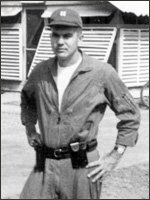

Arthur Dale Baker was a Captain in the United States Air Force when he went Missing in Action in Laos on 07 April 1965. Baker was born on 30 July 1933, and his home city of record is San Antonio, Texas. His status was later changed to Killed In Action/Body Not Recovered. Baker's remains were returned, identified, and buried in 2005.
Remarks
Last seen on dive thru thin clouds.
The Incident
On 07 April 1965, Capt. James W. Lewis, pilot, and then Capt. Arthur D. Baker, navigator, comprised the crew of a B57B (serial # 53-3880T) on a multi-aircraft strike mission in extremely rugged, jungle-covered mountains approximately 18 miles west of the Lao/North Vietnamese border, 4 miles south of Ban Chuong La and 4 miles southeast of Ban Niang, Xiangkhouang Province, Laos. Their target was enemy traffic along Route 7. This area of Laos was considered a major artery into the infamous Ho Chi Minh Trail. When North Vietnam began to increase its military strength in South Vietnam, NVA and Viet Cong troops again intruded on neutral Laos for sanctuary, as the Viet Minh had done during the war with the French some years before. This border road was used by the Communists to transport weapons, supplies and troops from North Vietnam into South Vietnam, and was frequently no more than a path cut through the jungle covered mountains. US forces used all assets available to them to stop this flow of men and supplies from moving south into the war zone.
At 1110 hours, Captain Lewis initiated a bomb run on an enemy target on Route 7 and was seen by his wingman as he descended through a thin cloud layer. His wingman did not see or hear from him again. Another member of the flight heard Capt. Lewis call "off target and out bound." The rest of the flight members conducted their attack passes, then returned to base as briefed. Because it was not uncommon for the aging bombers to separate during flights to and from base, no one was concerned until the Canberra failed to return to Bien Hoa Airbase at the scheduled time. A communications and ramp check of all airfields in the area was conducted and by 1400 hours it was determined the aircraft had not landed at any other base.
On 07 April aerial search efforts were initiated by search and rescue (SAR) and Air America aircraft in a 10 to 20 nautical mile radius of the target location, and continued through 12 April. These SAR operations were terminated when they failed to produce any indication of the crash site or any trace of the downed aircrew. Both crewmen were initially reported missing in action in South Vietnam while on a classified mission. Their loss location was later changed to Laos.
According to US intelligence reports, both Capt. Lewis and Capt. Baker successfully bailed out of their damaged aircraft and both men were known to be alive on the ground afterward. Likewise, both the Canberra's pilot and navigator are listed in the Department of Defense's April 1991 "Last Known Alive" list. One of the Intelligence Information Cables generated by the CIA, dated 25 June 1968, documents an incident correlated to Capt. Lewis. The report states: "On 10 June 1968 two of four American pilots held in the Tham Sua cave at VH193564, south of Ban Nakay Neua, Houa Phan Province, Laos, were sent to Hanoi, North Vietnam. Prior to being sent to Hanoi, one of the American pilots, described as an older man, killed three NVA soldiers when they attempted to interrogate him. The elder pilot refused to answer the NVA officers' questions and instructed the other pilots not to cooperate as well. The killing occurred when the North Vietnamese attempted to chain the pilot to a desk-he overturned the desk on his captors and beat three of them to death with the chain before guards overpowered him. Following this incident, the elder pilot and one of the younger pilots were sent to Hanoi. The reason given for the transfer was that the two pilots were considered incorrigible cases by the Pathet Lao and North Vietnamese. It is not known if the other American pilots have been transferred to North Vietnam for similar reasons."
In January 1974 Major Baker's next-of-kin requested his case review go forward and he was declared killed in action, body not recovered. Lewis was declared dead/body not recovered, in April 1982. Returning POWs were unable to provide any information on the fate of these two servicemen.
Personal Information
Arthur Baker, the oldest son of Arthur M. and Hazel Granberry Baker, was born on 30 July 1933 in Teague, Texas. Baker graduated from Pittsburg High School in 1951, and he joined the United States Air Force in 1954. Arthur Baker was promoted to the rank of Major during the time he was maintained missing.
Remains Returned
On 29 July 2005, memorial services were held for Arthur Baker in Longview, Texas. I had the privilege of attending the funeral and talking with his family, particularly his sister. The services were beautiful, and a fitting tribute to a fine American. The Baker family suggests that memorials be made to any Veterans of Foreign Wars post.
Sources
Biographical and incident of loss information was obtained from either POW/NET and/or Task Force Omega, Inc (unless otherwise noted). Additional information may be found via remembrances at The Vietnam Veterans Memorial Fund or The Virtual Wall Vietnam Veterans Memorial. Some personal information obtained from Baker's online memorial obituary. Photo obtained from his Virtual Wall memorial and used with his daughter's permission.